Search
Food corner

"...eating is more than a private, physiological act. It connects us to people and places all over the world - past, present and future."

Warren Belasco

Twitter feed
Tags

Entries in mint (7)

Wednesday
May112011

Middle Eastern mezze no.7: Fattoush

For those of you who haven’t heard of this delicious salad, Wikipedia offers a detailed explanation:

Fattoush ... is a Levantine bread salad made from toasted or fried pieces of pita bread (khubz 'arabi) combined with mixed greens and other vegetables ... To make fattoush, cooks use seasonal produce, mixing different vegetables and herbs according to taste, while making use of pitas that have gone stale ... Sumac is usually used to give fattoush its sour taste.

As you can gather this is not an easy dish to write a recipe for since the only constant ingredient is bread, and even with that there is a choice, albeit an obvious one. Toasted stale bread versus crispy, crunchy, shards of golden goodness; you know which gets my vote. 

As for the vegetables, all the fattoush I’ve tried have had tomato, cucumber and onion in them, but they can also have peppers, radish, lettuce, cabbage, carrot... the list goes on.  Mint is the usual choice when it comes to herbs, although I have had it with flat leaf parsley too.

Feta and olives are sometimes added, but I find this makes it too much like a Greek salad and prefer to leave the fried bread to steal the show. This leaves me with a difficult choice because feta and olives go so well with the rest of the mezze... so I chose not to make one; if I make a fattoush, I do a bowl of feta and olives as another part of the selection. Problem solved.

Click to read more ...

Tuesday
Apr122011

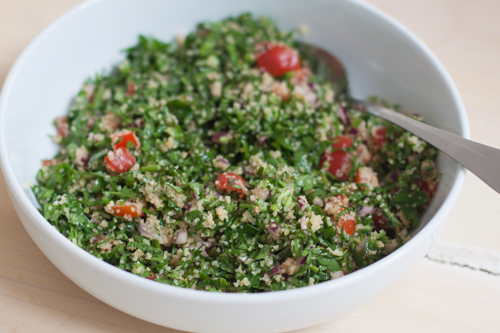
Middle Eastern mezze no.4: Tabbouli

I read the Saturday Guardian magazine religiously, my favourite sections naturally being those on food and drink, although Tim Dowling’s column comes a close second. So I was very pleased one Saturday morning a few years back to find that Yotam Ottolenghi had dedicated his column to this favourite salad of mine. The subheader had its desired affect, drawing me in with the following statement:

There's a right way and a wrong way to make this brilliant Middle Eastern salad, says Yotam Ottolenghi. Here's the right way...

Had I been making it the right way all these years? A perfectionist through and through, I was very pleased to find that I had. 

The most common issue is the proportions – far too many cooks do not realise that parsley is the star of the show here, not the bulgar … Another biggie is the way the herbs are chopped, and in this instance I'm afraid I must side with the purists and shun the food processor. Chopping the leaves with a razor-sharp, heavy knife, although a lot of work, prevents bruising and gives the parsley its light and dry texture.

“Tell me something I don’t know,” my Australian readership is probably thinking, “talk about stating the obvious."

Click to read more ...

Thursday
Apr072011

Middle Eastern mezze no.3: Hugh Foster's spicy lamb mince


Hugh Foster is often credited with having introduced Sydneysiders to Morrocan and Middle Eastern food in the 1990s with his trendy Darlinghurst restaurant, the Fez. The Fez is now closed, but he continues the theme with Café Mint in Surry Hills which has been open since the early noughties and still draws a large crowd, a testament to his ability to keep up with the times.

Café Mint’s takes the successful Sydney café model – communal tables, sleek furnishings and interior, good coffee, all day breakfasts which merge into lunch and dinner – but adds a twist, North African cuisine. Alongside the usual breakfast offerings of sourdough toast, bircher muesli, and scrambled eggs, you have breakfast cous cous with yoghurt, merguez sausage with chakchouka, and baked eggs with beans and sucuk.

My Dad did a stint working at Café Mint after he closed his own restaurant. It was probably around this time that Middle Eastern mezze became a regular part of our weeknight dinner menu. One of my favourite of these recipes is Hugh’s spicy lamb mince with pine nuts, which has made appearances on Cafe Mint’s breakfast, lunch and dinner menu over the years.

Click to read more ...

Sunday
Apr032011

Middle Eastern mezze no.2: Falafel

Updated on Tuesday, April 12, 2011 at 7:51PM by Registered CommenterVix

Falafel is one of those foods which you either love or hate.

Or is it?

I think the people who hate it just haven’t had the good stuff.  

When falafel is bad, it is really bad – bland and dry, you might as well be eating cardboard. It is a pity that this is many people’s only experience of falafel, because the problem is so easily remedied; add more! More spices, more herbs, more garlic, more salt. This may seem obvious, but in practice more people turn out bland falafels, than aromatic and fragrant ones, so it is worth driving the point home.

At first glance, 4 tablespoons of cumin, 3 bunches of herbs, 6 cloves of garlic and 3 tablespoons of salt may seem excessive, but bear in mind that this falafel mixture makes 20 to 30 balls. You can test your falafel mix by frying a small bit of the mixture to check the seasoning; if it doesn’t taste right, add more!

Click to read more ...

Monday
Feb072011

Larbilicious

One of the nice things about writing this blog is that I find out a lot of interesting things in the process. I have been making larb for years – it is a staple canapé for our annual Christmas Eve party and Dad entrusted me with it early on because it is extremely easy. I have always thought it was ubiquitous in Thai cuisine, just as it is in Sydney’s Thai restaurants, but I have just discovered that it is actually a regional dish from Isan, in north east Thailand, and probably originated further afield. In his book, Thai Food, David Thompson shares some theories on the salad’s historic origins:

A larp is an ancient salad. Some argue that it has the same origins as steak tartare, raw meat eaten with onions. The merchants of this part of Asia, the Haw, may have helped to spread the dish from the south-west of China and now, throughout northern Thailand, there are adaptations of this style of salad. 

Wikipedia suggests that larb may have come to Thailand from Laos:

Laotian cuisine has strongly influenced the neighboring cuisine of Northeastern Thailand (Isan) ... The most famous Laotian dish is Larb ... a spicy mixture of marinated meat and/or fish that is sometimes raw (prepared like ceviche) with a variable combination of herbs, greens, and spices. 

Click to read more ...